



Tianruide: On-site preparation of lithium battery materials such as CNT paste and dispersants is a critical step in enhancing battery performance.
The on-site preparation of lithium battery materials such as CNT slurry and dispersants is a critical step in enhancing battery performance. Its core lies in the coordinated integration of powder dispersion technology, equipment selection, and dispersant optimization.
A. The core process of on-site preparation of CNT slurry
The on-site preparation of CNT slurry usually includes the following three stages:
1. Wetting stage: The solvent comes into full contact with the surface of CNT powder, expelling air from the agglomerates and replacing them with the solvent.
2. Dispersion stage: By using mechanical shear force (such as high-speed stirring and grinding) to break the CNT bundle, single or small bundle dispersion can be achieved.
3. Stabilization stage: The dispersant adsorbs onto the surface of CNT, forming steric hindrance or electrostatic repulsion to prevent secondary agglomeration.
This process requires strict control of the feeding sequence, shear strength, temperature, and time to avoid excessive fracture of CNTs, which can reduce the aspect ratio and affect conductivity.
B. Key equipment and technological roadmap
The current mainstream on-site preparation equipment includes:
1. High speed disperser+colloid mill/homogenizer: suitable for small and medium-sized or pilot production lines, can effectively handle high viscosity systems.
2. Circular high-efficiency pulp making system (such as Tianruide NMP recovery and on-site purification closed management plan):
(1) Gradually introduce solvents and powders to maintain low viscosity;
(2) The slurry is circulated multiple times through the high shear zone to ensure uniformity;
(3) Supports high solid content (>30%), suitable for large-scale continuous production.
3. Vertical Grinding and Dispersing Machine: Designed specifically for CNT, it can handle high flow, high viscosity slurries while protecting the CNT structure from damage.
4. Twin screw continuous pulping system: integrating dry mixing, kneading, dispersion, and degassing, suitable for TWh level mass production, with small footprint and low energy consumption.
Tianruide's CNT dispersion pulping system has achieved a cost reduction of over 30% and is suitable for mainstream systems such as lithium iron phosphate.
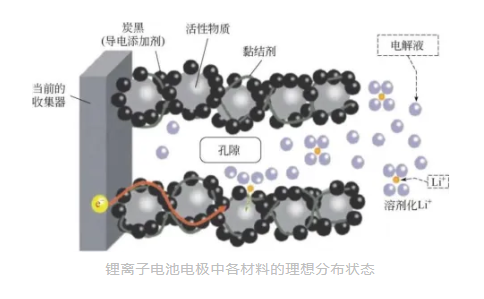 C. Selection and function of dispersants
Dispersants are crucial for the stable dispersion of CNTs. Common types include:
1. Polymer type: such as CMC (carboxymethyl cellulose) and PAA (polyacrylic acid), which stabilize particles through steric hindrance.
2. Ionic surfactants, such as SDBS (sodium dodecylbenzenesulfonate), provide electrostatic repulsion.
3. Specialized dispersants such as Hypermer KD-1, HAPBI-3, etc. can enhance the conductivity of graphene/CNT/carbon black composite slurries.
4. The dosage of dispersant is usually 5%~20% of CNT mass, which needs to be optimized through experiments to balance the dispersion effect and electrode impedance.
D. Advantages and challenges of on-site preparation
Advantages:
1. Avoid settling or agglomeration during the storage process of the slurry;
2. The solid content and viscosity can be flexibly adjusted according to the electrode formula;
3. Reduce transportation and warehousing costs.
Challenge:
1. CNT has a high specific surface area (up to 460 m ²/g) and is highly prone to aggregation, requiring strong shear and efficient dispersants;
2. High requirements for equipment cleanliness, metal impurities may cause micro short circuits;
In the dry process, CNT powder needs to be pre treated to adapt to a solvent-free environment.
Tianruide is the founder of the closed cycle utilization solution for NMP solvent plants. This system can purify and regenerate NMP waste liquid and prepare various lithium battery materials such as CNT slurry and dispersants on-site in lithium battery plants, greatly reducing the production cost of lithium batteries. Tianruide has launched a ready to use CNT powder for dry electrodes, which can be directly used for dry electrodes without the need for pulping through proprietary technology to control agglomeration
1. Energy density increased by 8%;
2. Increase cycle life by 30%;
3. It has been certified by major lithium battery companies.
This technology is expected to reduce solvent usage and promote green manufacturing.